Between Merit and Chance: Social Inequality and School Choice in Mexico City's Upper Secondary Education Admissions Reform
Abstract
In 2025, the admission system for public upper secondary education in Mexico City was reformed, intending to end the use of the standardized test used to assign students to schools and replace it with a lottery. However, because the most selective high schools refused to abandon the exam, the reform resulted in a two-track system: a lottery for most schools and an exam for the most selective ones. While the reform aimed to increase equality of opportunity in the transition to upper secondary schooling, its impact is uncertain, as the two-track system increased differences in applying to each segment of schools in a context already characterized by institutional heterogeneity and social segmentation in access to the most selective high schools.
Using rich administrative data and logistic regression, this thesis analyses how the change in the admissions system affected the relationship between an applicant’s social origins and educational characteristics and their decision to apply to the schools that require an exam. It finds that under the new system, the share of applicants choosing exam schools decreased from 78.6% to 59.2%. This drop was driven by a strengthening of the link between applicants’ social origins and educational characteristics and their choice of exam-requirement schools, as these variables became stronger predictors in the new system. These findings highlight the difficulty of isolating the admissions reform, in its attempt to increase equality of opportunity, from the broader inequalities it operates within. They also show how the design of educational systems closely interacts with the dynamics of social inequality, pointing to the need to address heterogeneity among schools and the factors that result in differences in students’ social and educational characteristics, as necessary steps to increase equality of opportunity in the transition to upper secondary schooling.
Introduction
Filing into a school early in the morning, surrounded by thousands of other young people, to take an exam and then going home to nervously await its results had become a rite of passage for those applying to public secondary education in Mexico City. That changed in 2025, when the federal government announced it would stop using the test that had been used to distribute applicants among high schools since 1996. The exam, according to the government’s argument, presented itself as a fair competition, but obscured how differences in its results reflected applicants’ disparities in socioeconomic origins rather than abilities or effort. In their view, the exam legitimized social inequality, rather than neutralizing it. The test was replaced with a lottery, a change that was presented as more than a policy modification. It was described as a philosophical reorientation from meritocracy to undifferentiated access, meant to distribute the chances of admission more evenly across applicants regardless of their origins, rather than consistently rewarding those who were already advantaged.
Although the reform intended to stop the use of the exam altogether, it did not achieve its goal. After the National University (UNAM) and the National Polytechnic Institute (IPN) pushed to retain the exam, the result was a hybrid admissions system. It mixes a lottery track for most schools with an exam track for the UNAM and IPN schools, which are by far the most selective institutions. Which track an applicant entered was determined by the schools they applied to. Applicants who included any UNAM or IPN school in their school selection had to prepare for and sit the exam, competing for admission based on their results. Those who applied only to the other schools simply entered the lottery and waited for the draw. The reform had set out to eliminate the exam, but instead, it made opting into it a deliberate decision linked to school choice.
The transition to upper secondary education in Mexico City is shaped by a combination of heterogeneous schools and applicants from highly unequal social origins, which under the old system resulted in social segmentation of students among schools (Blanco, 2014; Cobos Marin, 2023; Rodríguez Rocha, 2015; Solís, 2013). By focusing on how the new public admissions system affected applicants’ school selection, this thesis analyzes how the introduction of the new two-track admissions system altered the relationship between applicants’ social origins and educational characteristics and their school choice behavior.
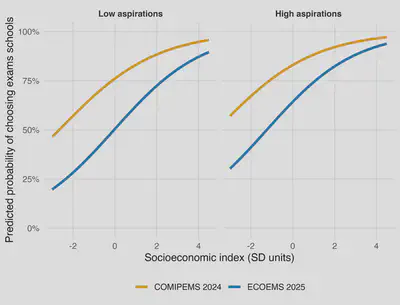
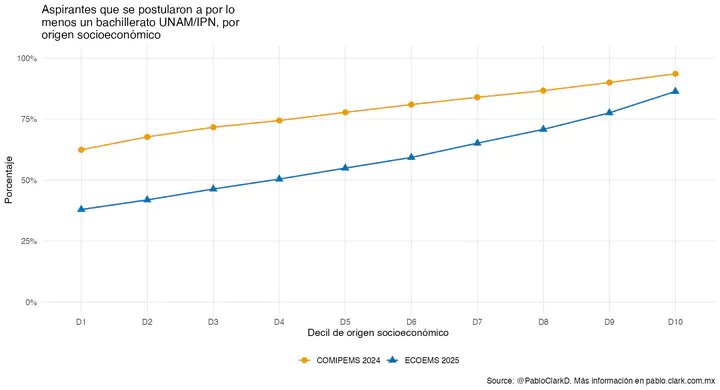
After the change in admissions systems, the share of applicants choosing exam schools decreased from 78.6% in 2024 to 59.2% in 2025. This drop was driven by a strengthening of the link between applicants’ socioeconomic and educational characteristics and their choice of exam-requirement schools, as these became stronger predictors in the new system. The decline in the choice of exam schools was concentrated among those with lower socioeconomic origins and weaker educational aspirations to reach higher levels of schooling. Among them, the probability of selecting exam-requirement schools dropped from 57.1% to 28.2%, compared to a decline from 96.5% to 92.3% among high-socioeconomic and high aspiration applicants.
The introduction of the two tracks in the admissions system changed the conditions under which applicants decide which schools to apply to. The drop in applicants selecting exam-requirement schools reflects how applicants’ school choices became even more bound up with calculations about the costs and likely outcomes of the admissions tracks, each representing a different logic of accessing opportunities: merit in the exam and chance in the lottery. Those deliberations led applicants in different social positions to apply to dissimilar schools, as part of their strategies to secure access to one of their preferred schools. Motivated by a philosophical shift from meritocratic competition to undifferentiated access, the reform intended to decrease the weight of applicants’ social origins on their trajectory. However, the unintended introduction of two-track, exam- and lottery-based mechanisms led to more pronounced social segmentation in school choices than existed under the previous system.
This thesis contributes to research on inequality of opportunity in the transition to upper secondary education, and to questions about how the design of admissions institutions interacts with the role of social origin in educational trajectories. By highlighting the difficulty of isolating the admissions reform from the broader social and educational inequalities it operates within, its findings point to the obstacles in translating views of fairness in education into equality of opportunity. At the same time, it supports previous studies that show how the design of educational systems shapes, rather than merely reflects, the dynamics of social inequalities. As necessary steps to increase equality of opportunity in the transition to upper secondary schooling, it points to the importance of addressing heterogeneity among schools and the factors that result in differences in students’ social and educational characteristics.
This thesis is organized in six sections. Section 2 reviews research on educational inequality, specifically in upper secondary schooling in Mexico City. Section 3 provides an overview of education in Mexico and of the changes to Mexico City’s admission system. Section 4 describes the data sources and methodology underpinning the results presented in Section 5. Finally, Section 6 synthesizes those results and concludes by outlining its theoretical and policy implications around social inequality in educational trajectories.
Results
Average marginal effect (AME) on the probability of choosing exam schools
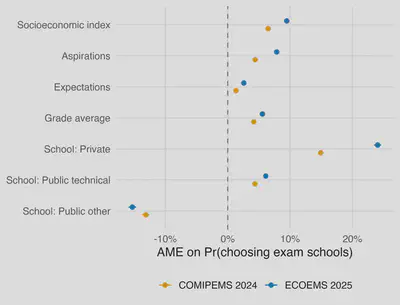
Note: Reference category for school type is public general. Confidence intervals at 99%.
Predicted probability of choosing exam schools across the range of SES and Aspirations, by cohort.
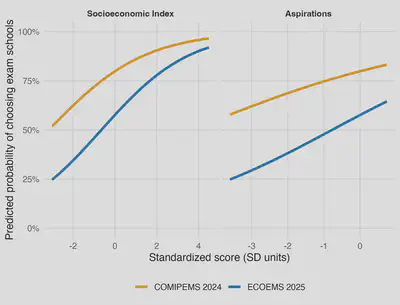
Predicted probability of choosing exam schools by SES conditioned by low and high aspirations, by cohort.